Why investigate it
- Reduces manual fastener handling
- Controls orientation and one-piece release
- Can confirm presence before the assembly cycle
- Integrates with drivers, presses, robots and fixtures
Separate and present screws, nuts, washers, pins, rivets and threaded inserts to automated drivers, robots, presses or controlled operator pick points.
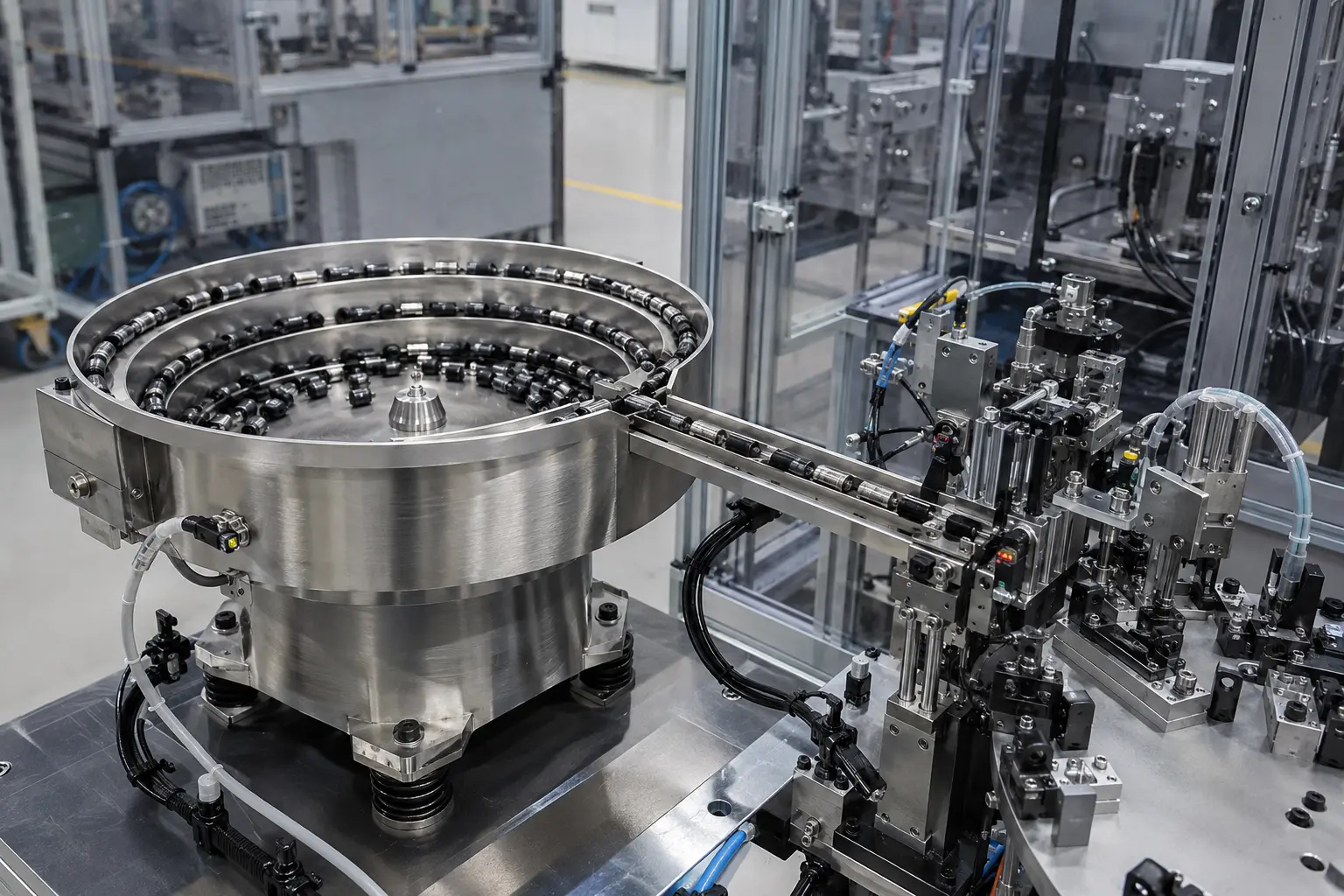
Automatic screw feeding converts loose fasteners into a confirmed, correctly presented supply. The route may use a rail presenter, bowl feeder, escapement, blow-feed tube or robot pick point depending on fastener geometry and the assembly process.
List every screw, nut, washer, pin, rivet or insert expected during the project life. Small changes in head, shank, thread, material, coating or oil can change singulation and transfer behaviour.
State whether the process needs a manual pick point, a precision robot pick pose, a feed tube into a driver nose, an escapement under a press or a counted group. The presentation controls the feeder and tooling choice.
Rail presenters suit accessible manual or robot pickup. Bowl and escapement systems can form a controlled queue. Blow feeding can transfer suitable fasteners through a tube, but geometry, distance, bends and orientation must be proven.
Mechanical separation, optical or inductive sensing, pressure monitoring and driver feedback can be combined to confirm delivery. The control response to a missing, double or jammed fastener should be explicit.
Test normal supplier variation, oil, coatings and worst-case tolerances. Record sustained delivery, rejects, jams, marking, tool access and recovery at the intended cycle.
| Area | Define | Why it matters |
|---|---|---|
| Fastener data | Head, shank, thread, length, material, finish and oil | Drives orientation, separation and transfer |
| Presentation | Pick point, escapement, tube, driver or press interface | Defines tooling and confirmation |
| Output | Fasteners per cycle, burst demand and buffer | Sizes feeder and queue capacity |
| Quality control | Presence, double feed, wrong variant and insertion feedback | Defines sensors and fault response |
Photographs or drawings, all expected variants, required hand-off and target sustained rate help identify the most credible next step.
Start a component reviewSee screws, nuts, washers, rivets and inserts as a component family.
Explore this route →Control the final queue and one-part release.
Explore this route →Prove transfer and confirmation with representative fasteners.
Explore this route →Loose screws are separated, aligned and presented one at a time at a pick point, escapement or feed tube for a driver, robot or operator.
Suitable screws can be transferred pneumatically, but head geometry, shank length, tube route, bends, surface condition and final orientation must be trialled.
Compatible sizes may share adjustable rails or change tooling. Wider differences can require separate tooling, recipes or feeders, with controls to prevent mixed fasteners.
Escapement geometry, queue control and sensors isolate and confirm one fastener. Driver or downstream feedback can provide another confirmation layer.
Potentially, but production oil changes friction and can contaminate tracks and sensors. Trials and maintenance planning should use parts in their real condition.
Define accepted output at the hand-off—not a feeder-only headline rate.