Why investigate it
- Automates repetitive manual counting
- Supports programmed batch quantities
- Connects to baggers, kit stations and cartons
- Can log counts, faults and recipe information
Singulate, detect, accumulate and release defined quantities of components into bags, kits, cartons or downstream machines with application-specific verification and controls.
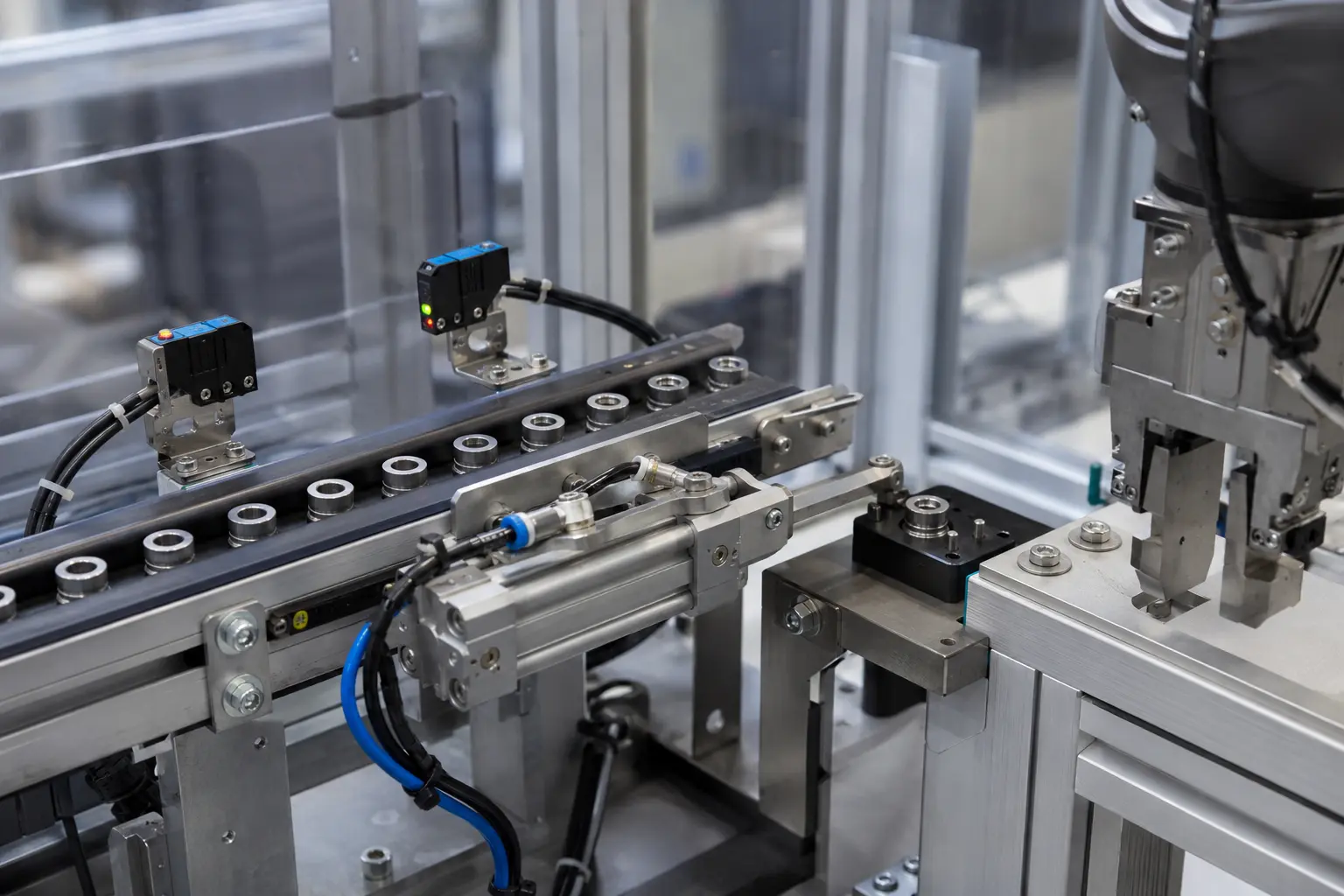
A component counting system first creates reliable single-file flow, then detects each accepted part, accumulates the programmed quantity and releases the batch only when the count and receiving process are ready.
Accurate counting depends on a controlled gap or defined detection event. Bowl, linear, step or conveyor feeding may be used to create single-file flow before the sensor.
Optical, laser, vision, inductive or other sensors are selected around size, material, transparency, speed and spacing. The response to touching parts and uncertain signals must be defined.
A gate, trap box, weigh check or buffer holds the programmed quantity until the receiving bag, kit, carton or machine is ready. Geometry should avoid bridging, bounce-out and damage.
The controller should distinguish counting complete from batch physically discharged. Recovery for under-counts, over-counts, blocked chutes, missing containers and operator intervention is agreed in the sequence.
An HMI can store batch quantities, formats and timing. Counts, totals, faults and selected traceability data can be exchanged with downstream controls where required.
| Area | Define | Why it matters |
|---|---|---|
| Component | Dimensions, material, finish, weight and tendency to touch or overlap | Determines feeding and sensor selection |
| Batch | Quantity range, tolerance, product change and accumulation volume | Defines gate and buffer design |
| Receiving process | Bag, carton, kit, machine demand and ready signal | Controls timing and discharge confirmation |
| Evidence | Count accuracy, test duration, rejects and recovery | Defines meaningful acceptance |
Photographs or drawings, all expected variants, required hand-off and target sustained rate help identify the most credible next step.
Start a component reviewPresent fasteners to drivers, robots or counting sensors.
Explore this route →Create single-file flow and controlled batch release.
Explore this route →Connect counting, bagging and line controls.
Explore this route →Typical applications include screws, nuts, washers, fixings, moulded components, electrical parts and other items that can be reliably separated and detected.
Accuracy is application-specific and depends on singulation, sensor performance, speed, component variation and the agreed response to uncertain detections. It should be proven with representative parts.
Yes. The controls can wait for a bag-ready signal, release the completed batch and confirm discharge before beginning the next quantity.
Programmed quantities and recipes can be provided within the mechanical and sensing range of the system.
Upstream singulation, track geometry, spacing control and a suitable sensor or vision method are combined. Worst-case touching and overlap should be included in trials.
Define accepted output at the hand-off—not a feeder-only headline rate.