Why investigate it
- Reduces dedicated orientation tooling for suitable parts
- Supports larger or variant-rich components
- Can connect directly to assembly, inspection or machine tending
- Recipes can manage defined product families
Detect, pick and present randomly positioned components from bulk containers using controlled replenishment, machine vision, robot handling and application-specific grippers.
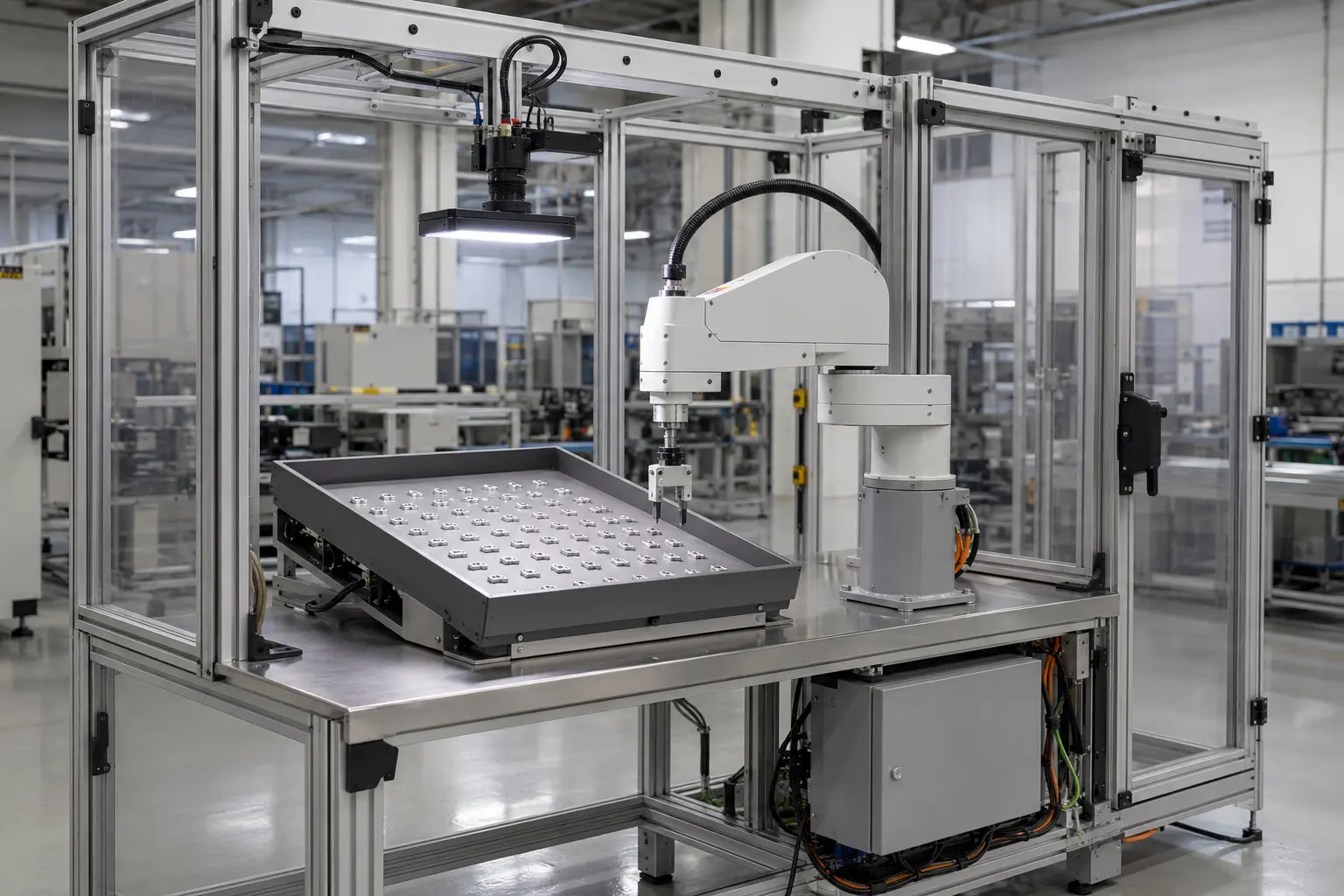
Robotic bin picking is considered when parts arrive in bins or totes and a robot must locate a usable pose without a dedicated orientation track. The complete cycle must manage visibility, gripping, collisions, part redistribution and empty-bin recovery.
Define the exact component pose, datum, tolerance and cycle required by the receiving fixture or machine. The robot path and gripper should be designed backwards from that accepted condition.
Flat or pre-separated parts may be located with controlled 2D imaging. Random bulk parts with height variation, overlap or unknown pose can require depth sensing and 3D localisation. Lighting and surface finish remain critical.
Bin picking still needs predictable material flow. Tote design, fill level, lifting or tilting, vibration redistribution and container exchange determine how many parts remain visible and reachable.
Vacuum, parallel, angular, magnetic or custom grippers are selected around access, surface, mass and the final placement. The sequence must define re-grip, failed pick, double pick and unpickable-part recovery.
Measure the complete loop through normal variation and low-bin conditions. Include image processing, robot motion, placement confirmation, redistribution, container exchange and interventions—not only one successful pick.
| Area | Define | Why it matters |
|---|---|---|
| Part and bin | Part family, material, dimensions, mass, bin type and fill range | Determines vision, gripper access and bulk behaviour |
| Accepted pose | Position, orientation, tolerance and receiving fixture | Defines the real output of the cell |
| Cycle | Sustained demand, surge, buffer and changeover | Separates useful output from a best-case robot move |
| Recovery | Failed pick, doubles, collisions, no-find and empty bin | Protects unattended production and uptime |
Photographs or drawings, all expected variants, required hand-off and target sustained rate help identify the most credible next step.
Start a component reviewSeparate parts on a programmable surface for vision-guided robot picking.
Explore this route →Use dedicated tooling for repeatable component families and controlled queues.
Explore this route →Define controls, guarding, hand-off and acceptance across the complete cell.
Explore this route →Robotic bin picking uses vision to identify the position and orientation of parts in a bulk container, selects a reachable item and guides a robot to pick and present it to the next process.
3D vision is often considered when parts overlap, sit at different heights or have random six-degree-of-freedom poses. The final choice depends on geometry, contrast, accuracy and cycle time.
Potentially, where the variants have detectable features and the training, confidence limits and reject response are defined. Representative good, bad and ambiguous samples are required.
The cell can redistribute parts, change viewpoint, request replenishment or trigger an operator call. Recovery logic must be part of the cycle-time and acceptance test.
Yes, subject to a defined mechanical hand-off, control interface, safety boundary, cycle requirement and access for recovery and maintenance.
Define accepted output at the hand-off—not a feeder-only headline rate.